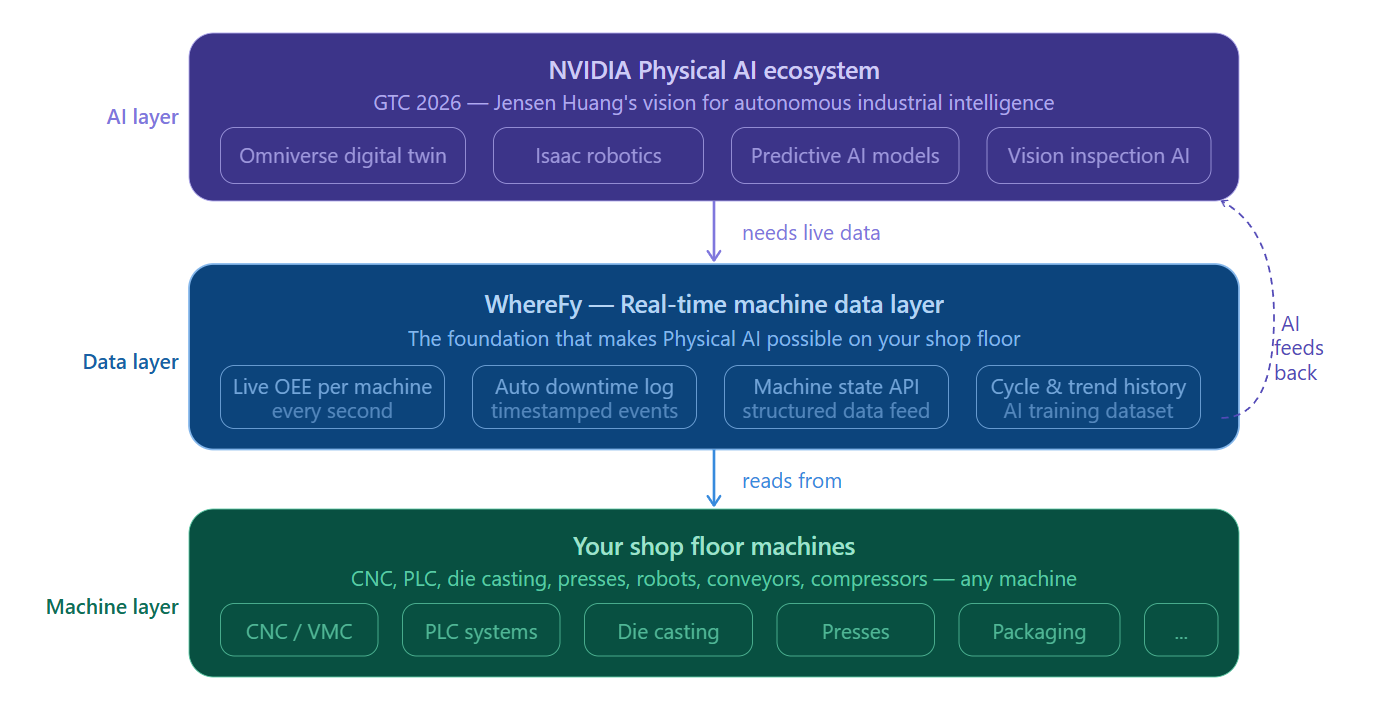
At NVIDIA GTC 2026, Jensen Huang walked onto the stage alongside a Disney humanoid robot and described a world where every company will build AI, and every industry will run on it. He wasn't talking about chatbots or dashboards. He was talking about Physical AI — machines that see, reason, and act inside real factories, in real time. For manufacturing, this is the most consequential technology shift since the PLC. And it starts with a question most Indian factories cannot yet answer: do you know what your machines are doing right now?
What NVIDIA GTC 2026 Actually Announced for Manufacturing
NVIDIA's GTC 2026 conference — held in San Jose in March 2026 — was not a GPU launch event. It was a declaration that AI has crossed from software into the physical world. Jensen Huang introduced the concept of Physical AI: AI systems that don't just process text or images, but operate within and interact with real physical environments — factory floors, warehouses, logistics networks, assembly lines.
Official Source
NVIDIA GTC 2026 — Jensen Huang Keynote
Read the full announcement on nvidia.com/gtc
The key announcements relevant to manufacturing included NVIDIA's Omniverse platform for factory simulation and digital twins, the Isaac robotics platform for autonomous industrial robots, and the concept of "AI factories" — data centres and software stacks dedicated entirely to running continuous AI inference inside physical operations. The underlying message was stark: AI is no longer something you deploy in IT. It is something that runs on your production line.
Physical AI Is Here. But It Has a Data Problem.
Here's what the keynote presentations at GTC 2026 didn't show enough of: what happens before the AI runs.
Every AI system — whether it's a vision model detecting defects, a robot navigating a factory floor, or a predictive maintenance algorithm watching motor vibration — needs data. Not historical data from last quarter's report. Not manual log entries. It needs live, continuous, machine-generated data from the exact moment something happens.
And here is the uncomfortable truth for most Indian manufacturers: they don't have it. The majority of Indian factories — from auto component plants in Rajkot to die casting units in Pune to printing facilities in Delhi — are still running on paper logs, shift-end summaries, and Excel sheets that are 6 to 24 hours old by the time anyone reads them.
"AI can move from observing operations to truly understanding them — but only when it has a reliable source of operational truth."
You cannot run Physical AI on paper. NVIDIA's Omniverse can simulate your factory perfectly — but the simulation is only as good as the real-time data feeding it. Jensen Huang's vision of autonomous AI factories requires a continuous stream of machine state data: what is running, what is idle, what has faulted, what is running slow, what is about to fail. That data layer has to come from somewhere. In a WhereFy-connected plant, it already exists.
The 5 Ways Physical AI Will Change Your Shop Floor
1. AI-Powered Defect Detection
Vision AI systems can now detect surface defects, dimensional errors, and assembly mistakes in real time. But these systems need to know machine state to function correctly: What part number is loaded? What is the cycle count?
What you need ready
Live machine state data per cycle — exactly what WhereFy provides via PLC or sensor connection.
2. Autonomous Mobile Robots
NVIDIA's Isaac platform is moving robots into production environments — carrying materials, feeding machines, removing finished goods. Robots need to know which machines are active to prioritize delivery.
What you need ready
A real-time machine availability feed that robots can query. WhereFy's API-accessible data layer makes this possible.
3. Predictive Maintenance AI
AI models trained on thousands of machine hours can identify failure patterns weeks before breakdown. But training data must come from real machines, in real operating conditions.
What you need ready
Continuous machine data streams — current draw, cycle time trends, temperature — logged automatically. WhereFy builds this from day one.
4. Digital Twins That Reflect Reality
NVIDIA's Omniverse allows photorealistic digital twins of factories. But a twin that isn't updated with real operating data is just an expensive 3D model.
What you need ready
A live data feed from every machine to update the digital twin in real time.
5. Closed-Loop AI Improvement
Advanced Physical AI systems observe outcomes, compare against expectations, and update parameters automatically — without human intervention.
What you need ready
Automated, timestamped machine event data. WhereFy logs every state change with millisecond precision.
The Roadmap: From Paper Logs to Physical AI
Phase 1: Connect & See
Months 1–3Connect existing machines via PLC, Modbus, or sensors. Eliminate paper logs. Start collecting real-time OEE and downtime data automatically.
Phase 2: Analyse & Optimise
Months 3–9Identify chronic downtime causes. Benchmark machines. Begin predictive maintenance scheduling based on actual operational patterns.
Phase 3: AI-Enable & Scale
Month 9+With a clean data foundation, integrate AI tools — vision systems, autonomous maintenance, robot coordination. WhereFy data becomes the live input for Physical AI.
Ready to Build Your Physical AI Foundation?
Connect your first machine in days. See live OEE, downtime, and cycle data immediately. Start building the data layer that NVIDIA's Physical AI future requires.