KEY TAKEAWAYS
- Track each kiln and temperature zone separately, with units and timestamps.
- Review temperature history alongside cycle phase, batch identity and data quality.
- Keep monitoring and supervisory access separate from the kiln’s protective controls.
In this resource
The application: several kilns, one operating view
For a kiln operation in Bakrol, Ahmedabad, a useful starting question is whether the team can see the current temperature and recent history of every kiln without moving between separate controller displays. A common overview can help an operator identify which kiln is heating, holding or cooling, then open its detailed trend.
Consider an illustrative site with three independently operated kilns. Their cycles start at different times, so a single current-temperature ranking says little about whether they are following the intended process. This guide is an application concept, not a claim of a completed WhereFy customer installation.
Define the temperature measurement for every zone
Create a tag list that identifies kiln, zone, instrument, engineering units, timestamp source and measurement quality. Record whether a displayed value is a measured process temperature or a controller setpoint. Where an existing controller exposes data, confirm its model, interface and accessible registers during the site survey.
A chamber or zone measurement should not be treated automatically as the temperature throughout the product load. Sensor location, instrumentation and the required process evidence determine what the reading can establish. Review the measurement arrangement with the equipment and process specialists before deciding that more dashboard detail will solve a measurement gap.
Use trends to explain each kiln cycle
The example graph below shows three different phases over the same eight-hour window. Kiln 01 approaches a holding phase, Kiln 02 is still heating and Kiln 03 is cooling. These synthetic curves demonstrate a dashboard layout; their temperatures and rates are not recommended operating conditions.
For an actual project, allow the operator to select a kiln, zone, time range and batch. Show process value and the applicable setpoint together when those signals are available. Keep gaps visible when readings are missing rather than drawing a continuous line that suggests uninterrupted measurement.
Give alarms and communication quality their own context
Agree which process conditions need an indication, who responds and how the event is recorded. A deviation from a setpoint is different from a disconnected sensor or a lost controller connection. Include the source, event time and acknowledgment state where the approved SCADA design requires them.
Thresholds, delays and operating limits must come from the equipment and process requirements. An illustrative trend cannot define safe conditions. Monitoring software and supervisory screens do not replace the kiln’s protective devices, approved interlocks or local operating procedures.
Connect temperature history with batch records
Associate the trend with a batch identifier, kiln identity, start and end events and the process phase information available from the controller or operator. Define the sampling interval and retention requirement around the questions the team needs to answer.
A batch review may compare the recorded profile with an approved process reference, investigate an interruption or establish which readings were unavailable. Temperature history provides evidence for that review; it does not by itself certify product quality, uniformity or regulatory compliance.
Scope a WhereFy SCADA and integration project
A WhereFy project discussion can cover equipment connectivity, a multi-kiln overview, zone trends, event history and the reporting or handover required by the application. Confirm the data acquisition method, controller permissions and any supervisory commands separately. A monitoring pilot can begin with an agreed subset of kilns and zones.
For a Bakrol or Ahmedabad enquiry, share the kiln count, zones per kiln, controller models, existing sensors, required graph intervals and the reports your team uses. Acceptance should include source-reading reconciliation, timestamp checks, offline indication and recovery tests. A wider turnkey scope can define installation, commissioning, operator instructions and ongoing ownership before implementation.
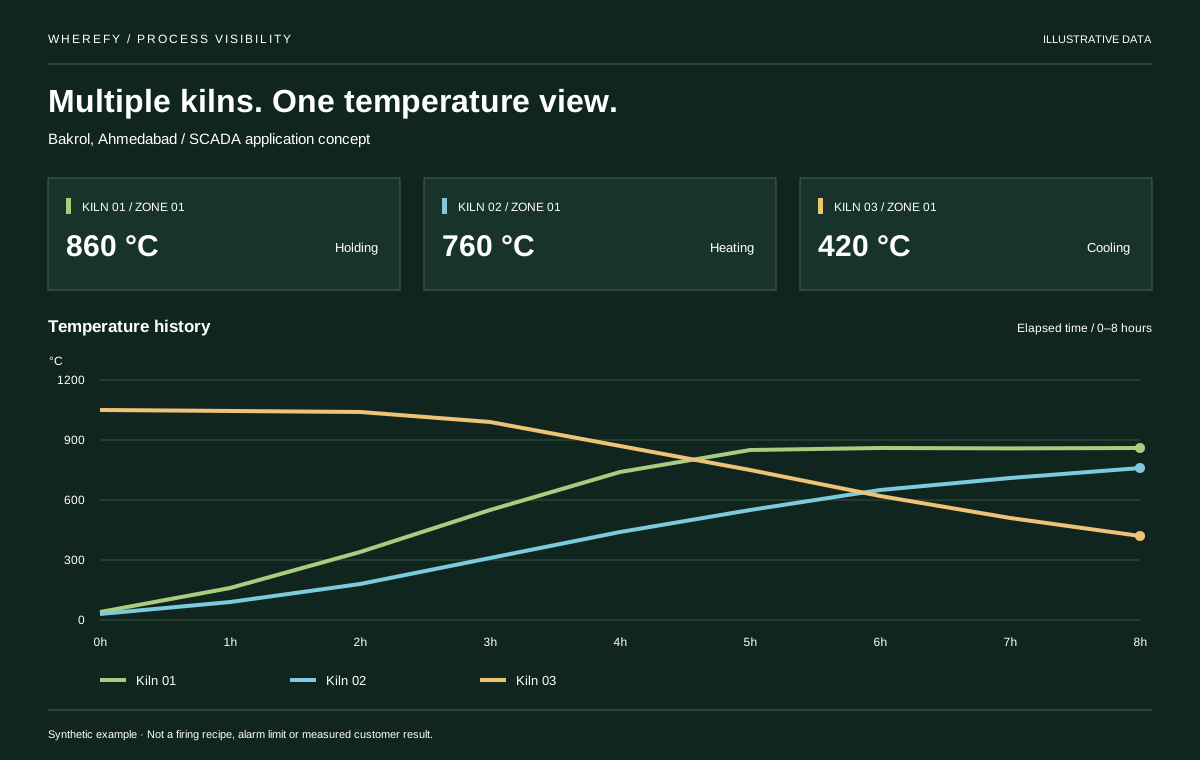
Reading the illustrative dashboard at 8 hours
| Asset / zone | Example temperature | Displayed phase |
|---|---|---|
| Kiln 01 / Zone 01 | 860 °C | Holding |
| Kiln 02 / Zone 01 | 760 °C | Heating |
| Kiln 03 / Zone 01 | 420 °C | Cooling |
Further reading
External references provide background. Their inclusion does not imply affiliation or equipment compatibility.
Have a site-specific question about these ideas?
Discuss your application